

Pelvic-floor exercises are often one of the first things people hear about when they develop urinary leakage. They are widely recommended for urinary incontinence, and for many people they can form an important part of managing symptoms. [1][2]
But what if your leakage seems worse after doing them? Or you feel uncomfortable, tense or unsure whether you are contracting the right muscles?
That does not necessarily mean pelvic-floor exercises are harmful. It may mean the exercises, technique, frequency, or an underlying bladder problem need closer attention.
What are pelvic-floor exercises?
Your pelvic floor is made up of muscles and connective tissues that support your bladder and bowel and help control urination.
Pelvic-floor muscle training involves deliberately contracting and relaxing these muscles. The aim is not simply to make them as strong as possible. Good pelvic-floor training also involves learning how to use the muscles correctly and relax them appropriately.
NICE recommends a supervised programme of pelvic-floor muscle exercises lasting at least three months as a first-line approach for women with stress or mixed urinary incontinence. [1]
The NHS also recommends pelvic-floor exercises as part of managing urinary incontinence. [2]

So, can pelvic-floor exercises make incontinence worse?
For most people, pelvic-floor muscle training is an established treatment for certain types of urinary incontinence. However, some people may notice increased discomfort, urgency or changes in leakage while exercising. This does not necessarily mean the exercises are harmful, but it may be a reason to review technique, the exercise programme or the underlying symptoms with an appropriately qualified healthcare professional.
One possible explanation is technique. If you are unsure whether you are contracting or relaxing the pelvic-floor muscles correctly, you may not get the intended benefit from the exercises. Appropriate guidance can help you learn the correct technique and understand how to contract and relax the muscles effectively.
Another important point is that urinary incontinence has different causes and patterns. Stress incontinence, for example, involves leakage associated with activities such as coughing, sneezing, laughing or exercise. Urge incontinence involves a sudden need to urinate that can be difficult to defer. Some people experience a mixture of both. [1][2]
Pelvic-floor training is therefore not a one-size-fits-all exercise programme.
If your symptoms consistently become worse when you exercise, it is sensible to stop assuming that simply doing more repetitions will solve the problem.
Could you be doing the exercises incorrectly?
This is more common than many people realise.
NICE highlights the importance of correct pelvic-floor muscle training and appropriate supervision, particularly when previous exercises have not improved symptoms. [1]
Pelvic-floor exercises can be surprisingly easy to get wrong. You might:
- squeeze your buttocks or thighs instead of the pelvic-floor muscles;
- hold your breath while exercising;
- tense your stomach more than necessary;
- forget to fully relax between contractions;
- do too many repetitions;
- or simply be unsure whether you are using the right muscles.
If you’re struggling with your technique, professional guidance may help you understand how to perform the exercises correctly. Read Also: Pelvic Floor Health and EMS Chair
Remember, pelvic-floor training isn’t a competition to see how many squeezes you can do. The focus should be on controlled movement, correct muscle engagement and allowing the muscles to relax properly.
What if you feel more pressure, discomfort or urgency?
If pelvic-floor exercises cause pain, significant discomfort, increased urinary urgency or a noticeable change in your symptoms, it is sensible to seek advice from an appropriately qualified healthcare professional.
Instead of increasing the intensity or frequency of the exercises, consider discussing your symptoms and technique with a healthcare professional to check whether the programme is suitable for you.
The pelvic floor needs to contract when necessary, but it also needs to relax. The right approach depends on the individual and the type of urinary symptoms involved.
A supervised programme may help establish whether you are contracting the muscles correctly and whether the exercise programme is appropriate for your symptoms. [1]

Why might pelvic-floor exercises not be helping?
There are several possible reasons.
You may not have completed the recommended training period yet. NICE recommends a supervised programme of at least three months for women with stress or mixed urinary incontinence. [1]
Alternatively, you may not be performing the exercises correctly.
There may also be another reason for your urinary symptoms that needs assessment.
Urinary incontinence is not one single condition. Your symptoms, medical history, medicines, pregnancy or childbirth history, bladder habits and other factors can all be relevant.
For that reason, persistent leakage should not automatically be treated as a simple “weak pelvic floor”.
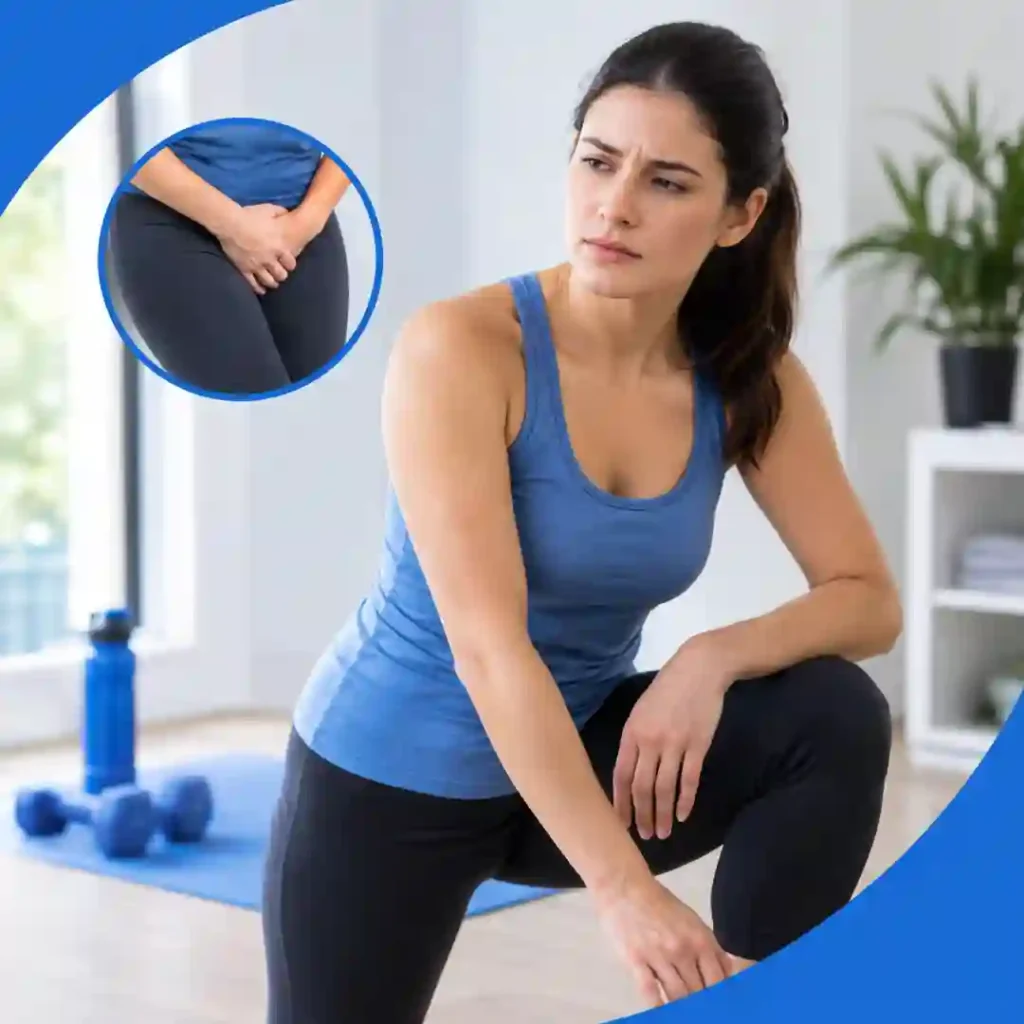
What should you do if exercises seem to make leakage worse?
If your leakage appears to worsen during or after pelvic-floor exercises, do not assume that doing more repetitions or increasing the intensity will improve the problem. Instead, review your technique, symptoms and exercise programme with an appropriately qualified healthcare professional.
Instead, consider whether:
- You are using the correct muscles.
- You are breathing normally.
- You are allowing the muscles to relax between contractions.
- Your symptoms are related to coughing, sneezing and movement, or instead involve urgency.
- The exercises consistently make your symptoms worse.
- You have other urinary symptoms that have not been assessed.
A healthcare professional or appropriately trained pelvic-health professional can help assess the problem and determine whether pelvic-floor muscle training is suitable.
When should urinary incontinence be medically assessed?
Urinary leakage is common, but that does not mean you have to live with it or diagnose the cause yourself.
If your symptoms persist, worsen or interfere with daily activities, consider seeking medical advice.
Seek an appropriate medical assessment if you have symptoms that could indicate another urinary or health problem, such as blood in the urine, pain when passing urine, difficulty emptying your bladder, recurrent urinary infections, or significant changes in urinary function. Check Out This Also: Pelvic Floor – Bladder, Bowel, and Beyond
A commercial treatment should not replace investigation of unexplained urinary symptoms.

Can pelvic-floor exercises replace other treatments?
Not necessarily.
Management should be tailored to the type of urinary incontinence, the symptoms involved, and the individual’s needs.
Pelvic-floor muscle training is an established conservative treatment, particularly for stress and mixed urinary incontinence, but it is not guaranteed to resolve every person’s symptoms. [1]
Other management approaches may be considered depending on the diagnosis. For example, NICE recommends bladder training alongside pelvic-floor muscle training for women with mixed urinary incontinence. [1]
This is why identifying the type of incontinence matters before deciding what approach is appropriate.
How long should pelvic-floor exercises take to work?
There is no reliable “one week” or “two week” promise that applies to everyone.
NICE recommends offering women with stress or mixed urinary incontinence supervised pelvic-floor muscle training for a minimum of three months. [1]
The NHS advises that pelvic-floor exercises may take some time before any improvement is noticed, and the timeframe can vary between individuals. [2]
If you have been exercising consistently for a reasonable period without improvement, review your technique and diagnosis rather than simply doing more.
What if pelvic-floor exercises are not working for me?
If pelvic-floor exercises do not seem to be helping, it may be useful to review your exercise technique, the type of urinary symptoms you are experiencing and whether the programme is appropriate for you.
You can also ask whether the exercise programme has been correctly matched to your symptoms.
Useful questions to discuss with a healthcare professional include:
- What type of urinary incontinence do I have?
- Am I contracting the correct pelvic-floor muscles?
- Am I relaxing them properly?
- Is my exercise technique correct?
- How often should I be exercising?
- Could another condition be contributing to my symptoms?
- Are there other treatment or management options I should consider?
A proper assessment can be much more useful than repeatedly following generic exercises from the internet.

Can Incontinence Direct advise me?
If you are considering treatment for urinary incontinence, it is important to understand your symptoms and seek appropriate clinical advice about whether a particular treatment or management approach is suitable for you.
Pelvic-floor exercises remain an important part of urinary incontinence management for many people, but more exercise is not automatically better. If exercises worsen your symptoms, cause discomfort, or don’t help, it is worth having the situation properly assessed rather than continuing unquestioningly.
Management should be considered according to your symptoms, individual circumstances and realistic expectations. Urinary leakage can have different causes, so it should not automatically be assumed to result from a weak pelvic floor.
Medical note: This article is intended for general information and does not diagnose or treat an individual condition. If you have new, persistent or worsening urinary symptoms, seek advice from an appropriate healthcare professional.
FAQs
Q: Can pelvic-floor exercises cause urinary leakage?
They should not be assumed to cause urinary leakage simply because leakage happens during or after exercise. If your symptoms repeatedly worsen while doing the exercises, review your technique and seek professional advice rather than increasing the amount of exercise.
Q: Should I stop pelvic-floor exercises if they make my symptoms worse?
If exercises consistently worsen your symptoms or cause pain or significant discomfort, seek professional advice before continuing or increasing them. The problem may be technique, the exercise programme or the underlying urinary condition.
Q: Will doing more pelvic-floor exercises give better results?
Not always. Pelvic-floor exercises work best when performed with good control and proper relaxation. Simply doing more repetitions or increasing the intensity does not necessarily make the exercises more effective.
Q: How long should I do pelvic-floor exercises?
For women experiencing stress or mixed urinary incontinence, NICE recommends a supervised pelvic floor muscle training programme for at least three months. [1] The advice and duration may vary depending on individual symptoms and clinical assessment.
Q: Why are my pelvic-floor exercises not working?
Possible reasons include incorrect technique, an unsuitable exercise programme, insufficient training time or an underlying condition that requires a different approach. NICE specifically highlights the importance of correct training and supervision. [1]
Q: Can pelvic-floor exercises treat every type of urinary incontinence?
No. Urinary incontinence has different forms, including stress, urge and mixed incontinence. Treatment should match the type and underlying cause of the symptoms.
Q: When should I see a doctor about urinary leakage?
If leakage persists, worsens or starts to affect your quality of life, seek medical advice. You should also consult a healthcare professional if you experience blood in your urine, painful urination, difficulty emptying your bladder or repeated urinary infections.
References & Further Reading
[1] NICE — Urinary incontinence and pelvic organ prolapse in women: management (NG123). Clinical guidance covering urinary incontinence and the role of pelvic-floor muscle training. https://www.nice.org.uk/guidance/ng123
[2] NHS — Urinary incontinence: treatment. Information on available treatments, including pelvic-floor exercises and other management options. https://www.nhs.uk/conditions/urinary-incontinence/treatment/
[3] NHS — 10 ways to stop leaks. Practical guidance and lifestyle measures that may help people manage urinary leakage. https://www.nhs.uk/conditions/urinary-incontinence/10-ways-to-stop-leaks/
[4] Bo K, et al. — Pelvic floor muscle training and overactive bladder. Review of evidence relating to pelvic-floor muscle training and overactive bladder symptoms. Physiotherapy, 2020. https://pubmed.ncbi.nlm.nih.gov/32026847/
[5] Cochrane Review — Pelvic floor muscle training with feedback or biofeedback. Review of evidence concerning pelvic-floor muscle training with feedback or biofeedback for urinary incontinence, published in 2025. https://pubmed.ncbi.nlm.nih.gov/40066950/
For further information, Please Call Us on 03300 100 026