
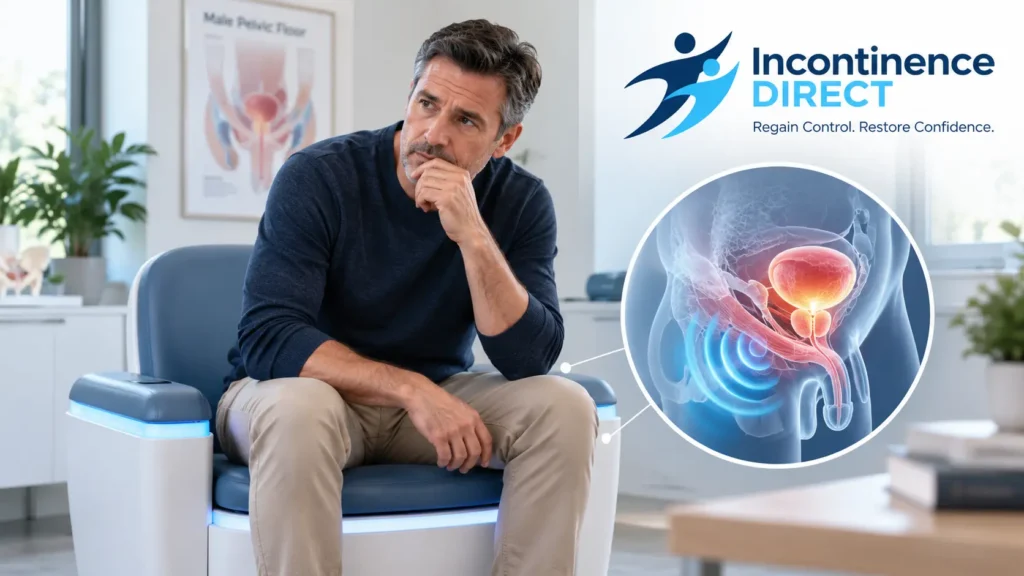
Do you have erectile dysfunction? Here at Incontinence Direct , we understand how this can impact your life and relationships.
From low self-esteem & confidence, Guilt and shame, Anxiety and depression, we understand that it is more than just a strain on your relationship. Do not suffer alone; read on to find out your options!
Erectile dysfunction (ED) means having difficulty getting or keeping an erection that is firm enough for satisfactory sex. It is common, but persistent erection problems can have many different causes, so finding out what may be contributing to the problem matters.
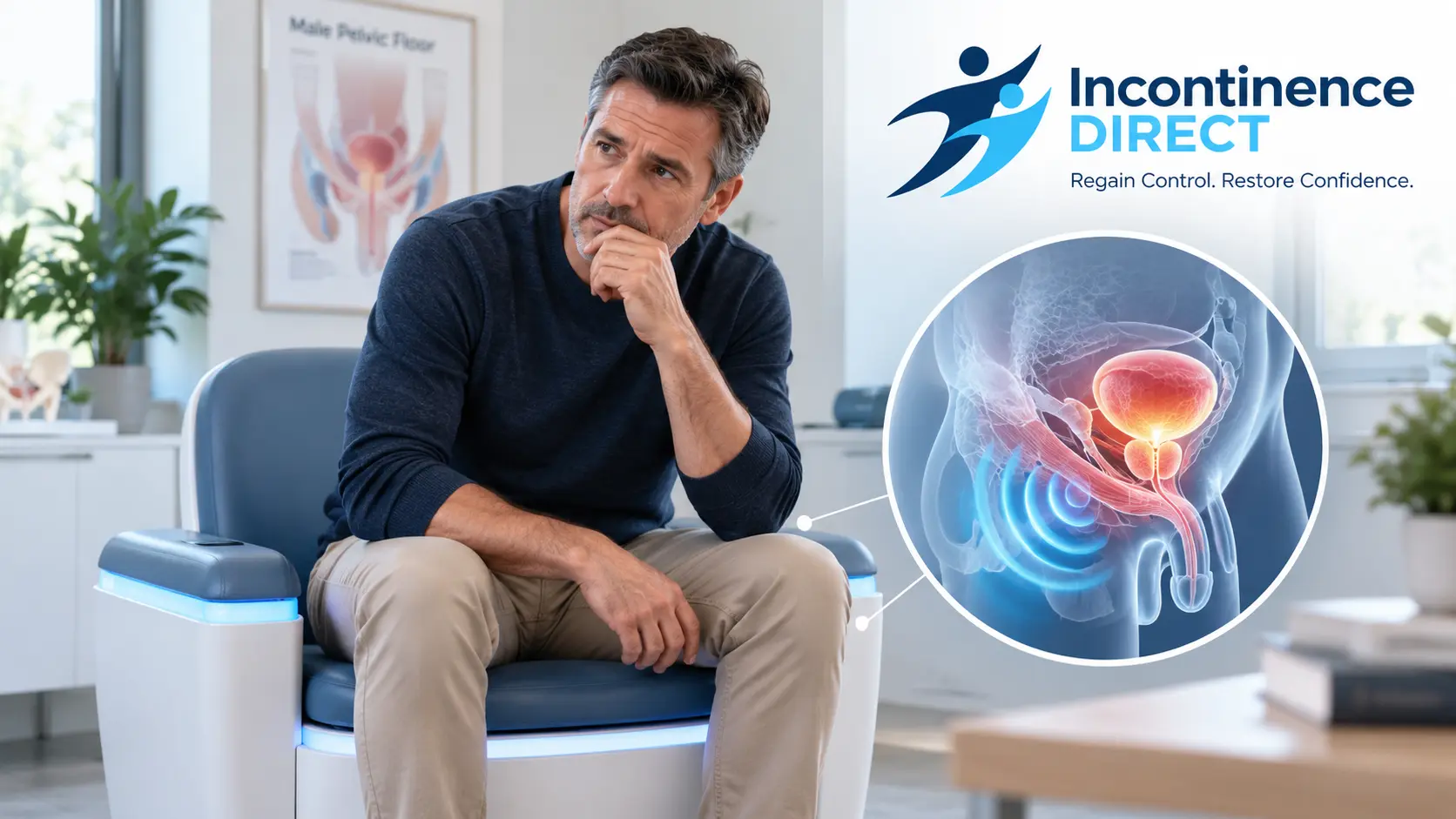
An EMS chair provides electromagnetic pelvic-floor stimulation while you remain seated and clothed. The treatment produces repeated contractions of the pelvic-floor muscles.
But there is an important distinction between using electromagnetic stimulation to exercise the pelvic floor and claiming that an EMS chair treats erectile dysfunction.
This article covers what is known about ED, the role of the pelvic floor, how an EMS chair works, what research has investigated, and where the current evidence does—and does not—allow us to make a treatment claim.
Understanding Erectile Dysfunction
ED, or Erectile dysfunction, is the persistent inability to achieve or even maintain a firm erection that is sufficient for satisfactory sexual activity.
Occasional difficulty getting an erection is common. Persistent problems are different and may be linked to an underlying health issue.
The NHS lists a range of possible contributors, including stress, tiredness, alcohol, some medicines, high blood pressure, high cholesterol, diabetes, depression, anxiety and hormone problems.
The European Association of Urology’s current guidance also recommends looking at medical and sexual history, physical health and relevant laboratory tests when assessing erectile dysfunction. This matters because ED is not a single condition with one cause.
If erection problems keep happening, it is therefore worth discussing them with a GP or another appropriately qualified healthcare professional rather than assuming that pelvic-floor weakness is responsible.
Common Causes of Erectile Dysfunction and Treatment Options?
ED can have physical, psychological, lifestyle and medication-related contributors.
Erectile dysfunction isn’t simply a regular part of ageing—it often arises from a combination of physical, psychological, and lifestyle factors. The most common causes include:
1. Blood vessel and cardiovascular factors
An erection depends on changes in blood flow within the penis. Conditions that affect cardiovascular health can therefore be associated with erectile dysfunction.
High blood pressure, high cholesterol and diabetes are among the health conditions identified by the NHS as possible contributors to ED.
2. Psychological and emotional factors
Stress, anxiety, depression and relationship difficulties can also affect sexual function. In some men, psychological factors may play a major role; in others, physical and psychological factors can overlap.
3. Hormonal Imbalance
Hormonal problems can contribute to sexual difficulties. Testosterone is one factor considered during medical assessment where clinically appropriate.
4. Medicines and other factors
Some medicines can contribute to erection problems. Alcohol use, smoking, excess weight and other lifestyle factors may also be relevant.
Because the possible causes are varied, a treatment that targets one part of pelvic function should not automatically be presented as a treatment for every form of ED.
Learn, How: Incontinence Direct Tackles Stress Incontinence

Can Pelvic-Floor Muscles Affect Erectile Function?
Research links pelvic-floor muscle function with erectile function.
A randomised controlled trial involving 55 men with erectile dysfunction investigated pelvic-floor muscle exercises combined with manometric biofeedback and lifestyle advice. The intervention group showed improvements in erectile-function scores compared with the control group at three months, with further improvement reported during follow-up.
That is useful evidence when discussing pelvic-floor muscle training.
It is not, however, evidence that every method of stimulating the pelvic floor produces the same result.
Pelvic-floor exercises performed voluntarily, electrical stimulation and electromagnetic stimulation are different interventions. Consider research findings in the context of the intervention, equipment, treatment protocol, population, and outcome being studied.
This distinction matters when considering an EMS chair for ED.
What Is an EMS Chair?
An EMS chair is a seated treatment system that uses electromagnetic stimulation to produce repeated contractions of the pelvic-floor muscles.
The person remains clothed during the session and sits on the treatment chair while the device delivers the stimulation.
The contractions are involuntary, meaning the person does not have to consciously contract the pelvic-floor muscles each time.
The purpose of describing the treatment this way is simply to explain what the equipment does. It should not be confused with a claim that the chair has been established as a treatment for the underlying causes of erectile dysfunction.
What Does the Research Tell Us About Magnetic Stimulation?
Research has investigated magnetic stimulation in pelvic-floor disorders, including studies involving erectile dysfunction.
A systematic review and meta-analysis published in Neurourology and Urodynamics assessed 20 studies involving 1,019 patients. The authors reported that the overall level of evidence was low and concluded that the applicability of magnetic stimulation in pelvic-floor disorders remained uncertain. The review noted that some trials had reported possible benefits for erectile dysfunction, but also called for larger and better-designed studies with longer follow-up.
That is an important qualification.
It means that the existence of research into magnetic stimulation should not be turned into a blanket statement that an EMS chair treats ED.
The exact equipment and intervention matter.
So, Does an EMS Chair Treat ED Without Surgery?
An EMS chair is a non-surgical treatment method, but that does not mean it should automatically be described as an established treatment for erectile dysfunction.
Evidence shows that pelvic-floor muscle training can improve erectile-function measures in some men, and research has explored magnetic stimulation for pelvic-floor disorders.
However, those findings do not establish a guaranteed or predictable result from the specific EMS chair service offered by Incontinence Direct.
For that reason, we do not describe the EMS chair as a cure for ED, a treatment for the underlying cause of ED, or a replacement for established medical treatment.
A more accurate description is that electromagnetic stimulation produces repeated pelvic-floor muscle contractions, while research into its clinical applications continues.
How Does an EMS Chair Session at Incontinence Direct, , Work?
The treatment process is straightforward.
1. You remain seated and clothed
The customer sits on the EMS chair without needing to undress for the treatment.
2. Electromagnetic stimulation is delivered
The equipment delivers electromagnetic stimulation that produces repeated contractions of the pelvic-floor muscles.
3. The intensity is adjusted according to the treatment protocol
The experience of stimulation can vary between individuals. The treatment should be delivered according to the instructions and requirements for the specific equipment being used.
4. The session ends without a surgical procedure
This treatment involves no surgical incisions.
Confirm the exact session duration, treatment schedule, and suitability criteria with Incontinence Direct before booking, rather than relying on a fixed number of sessions or promising a particular outcome.
The EMS (electromagnetic) chair sends focused electromagnetic pulses into the pelvic floor muscles with you seated fully clothed on the device. This results in thousands of deep contractions of the muscle (in a session) — much more than you can do with regular exercises.
Read More On Urinary Incontinence and EMS Chair Here: Tired of Frequent Bathroom Trips?
Over time, this strengthening may improve control, blood flow, and erectile performance. It is a non-surgical therapy with no downtime, and the sessions are often brief, which makes it ideal for those who wish to try a non-surgical option and optimise function without medication or surgery.
EMS Chair At Incontinence Direct and Other Approaches to Erectile Dysfunction
| Approach | How It Is Delivered | Main Purpose / Mechanism | What the Evidence and Guidance Say | Important Considerations |
|---|---|---|---|---|
| EMS Chair | Seated electromagnetic pelvic-floor stimulation while fully clothed. | Uses electromagnetic stimulation to produce repeated pelvic-floor muscle contractions. | Electromagnetic and magnetic stimulation have been investigated in pelvic-floor conditions, but evidence varies according to the intervention, equipment, treatment protocol and population studied. | Evidence for one form of pelvic-floor stimulation should not automatically be applied to every EMS system or treated as proof that the chair treats the underlying cause of ED. |
|
Oral ED Medicines PDE5 inhibitors such as sildenafil or tadalafil |
Taken orally according to the prescribed or supplied instructions. | Supports the physiological processes involved in achieving an erection by inhibiting the PDE5 enzyme. | PDE5 inhibitors are established medical treatments for erectile dysfunction and are recommended as a first-line treatment option in current EAU guidance. | Not suitable for everyone. A healthcare professional can advise whether a particular medicine is appropriate and whether other medicines or health conditions need to be considered. |
|
Intracavernosal Injections For example, alprostadil |
Medication is administered by injection into the penis. | Uses vasoactive medication to produce an erection. | Intracavernosal treatments are established options for ED and may be considered when oral treatment is unsuitable or ineffective. | Requires appropriate instruction and medical supervision. Possible complications include pain and priapism, among others. |
| Vacuum Erection Device | A mechanical device is placed around the penis to create a vacuum. | The vacuum draws blood into the penis to help produce an erection. | Vacuum devices are an established non-invasive, drug-free option for some men with ED. | A constriction ring may be used to maintain the erection. The approach may not suit everyone and can affect spontaneity or comfort. |
| Penile Prosthesis | A surgical procedure in which a prosthesis is implanted within the penis. | Provides a mechanical means of producing an erection when other treatment approaches have not been suitable or effective. | Penile prostheses are an established surgical option for selected men with ED, generally considered after other treatment approaches have been unsuccessful or unsuitable. | Requires surgery and carries surgical and device-related risks. Suitability should be assessed by an appropriately qualified specialist. |
| Important: These approaches work in different ways and should not be treated as interchangeable. An EMS chair provides electromagnetic pelvic-floor stimulation, while established ED treatments such as PDE5 inhibitor medicines, vacuum devices, intracavernosal treatments and penile prostheses have different mechanisms and evidence bases. The appropriate approach depends on the individual’s circumstances and the possible cause of erectile dysfunction. Speak with a GP or another appropriately qualified healthcare professional if erectile dysfunction is persistent, new or unexplained. | ||||
The best part? EMS Chair sessions are about half an hour long, involve no anaesthetic and zero downtime, so users can return to normal activities right away.
The NHS describes PDE-5 inhibitor medicines and vacuum pumps among established treatment options for ED. The current EAU guidance also recommends PDE-5 inhibitors as first-line therapy and identifies other options, including intracavernous injections and vacuum erection devices, depending on the individual circumstances.
This does not mean every established treatment is suitable for every man. ED treatment is generally selected according to the underlying factors, health status, preferences and response to treatment.
An EMS chair should therefore be considered as a different type of pelvic-floor stimulation service, rather than marketed as a superior alternative to established ED treatment.
What an EMS Chair Can and Cannot Be Expected to Do
It is useful to separate what the equipment does from what has been established clinically.
The EMS chair can be described as:
- a seated form of electromagnetic pelvic-floor stimulation
- a treatment delivered while clothed
- a method of producing repeated involuntary pelvic-floor muscle contractions
- a non-surgical treatment process
We do not promise that it will:
- cure erectile dysfunction
- restore erections in every user
- treat the underlying cause of ED
- improve penile blood flow in every person
- produce a particular level of erection firmness
- produce a result after a fixed number of sessions
- provide benefits lasting for a guaranteed period
- replace assessment or treatment from a qualified healthcare professional
Those distinctions matter because a treatment description and an efficacy claim are not the same thing.
Is an EMS Chair Suitable for Someone With ED?
Not necessarily.
Erectile dysfunction has several possible causes, and an EMS chair should not be assumed to be appropriate simply because someone has difficulty getting or keeping an erection.
Suitability also depends on the particular equipment being used, its manufacturer’s instructions, relevant contraindications and the individual’s circumstances.
If you have persistent or unexplained ED, medical assessment is important. The EAU recommends a comprehensive medical and sexual history and assessment of relevant health factors when evaluating erectile dysfunction.
Incontinence Direct can explain its EMS service and the applicable suitability criteria. It does not diagnose the underlying cause of erectile dysfunction.
What Treatments Are Normally Used for Erectile Dysfunction?
Treatment depends on the cause and the individual’s circumstances.
The NHS lists several approaches, including lifestyle changes, PDE-5 inhibitor medicines, vacuum pumps and treatment directed at an underlying cause where appropriate.
The current EAU guidance recommends lifestyle and risk-factor modification and identifies PDE-5 inhibitors as a first-line treatment option. It also discusses other approaches, including intracavernous injections and vacuum erection devices.
This is why persistent ED should not simply be treated as a pelvic-floor problem.
If an underlying medical, hormonal, cardiovascular, psychological or medication-related factor is contributing to the problem, identifying that factor can be an important part of deciding what treatment is appropriate.
What About Pelvic-Floor Exercises?
Pelvic-floor exercises are different from passive electromagnetic stimulation.
In the randomised trial described earlier, men performed pelvic-floor exercises with biofeedback and lifestyle advice. The study reported improvements in erectile-function measures, although not every participant achieved normal erectile function.
That research supports the statement that pelvic-floor muscle training has been investigated as an approach for men with ED.
It does not allow us to say that an EMS chair produces the same clinical outcome.
If you have been advised to perform pelvic-floor exercises by a qualified healthcare professional, those exercises should not automatically be replaced with an EMS session.
What About Blood Flow?
Blood flow is an important part of normal erection physiology, but this is another area where careful wording matters.
The fact that pelvic-floor muscles are involved in sexual function does not establish that strengthening them with an EMS chair increases penile blood flow sufficiently to treat vascular erectile dysfunction.
The NHS identifies cardiovascular and metabolic conditions as possible contributors to ED, while the EAU recommends assessing relevant cardiovascular and metabolic risk factors.
For that reason, we do not describe the EMS chair as a treatment for vascular erectile dysfunction or claim that it restores penile blood flow.
See Here: Can EMS (Electromagnetic Seat) Treat Bladder Leakage?

Frequently Asked Questions Around Erectile Dysfunction Symptoms & Treatment Options
Can an EMS chair treat erectile dysfunction without surgery?
An EMS chair is a non-surgical way of delivering electromagnetic pelvic-floor stimulation.
That describes how the treatment is delivered. It does not establish that an EMS chair is an established treatment for every form of erectile dysfunction.
Research has investigated pelvic-floor rehabilitation and magnetic stimulation, but the findings cannot automatically be applied to every EMS system or every man with ED.
Does an EMS chair strengthen the pelvic-floor muscles?
The stimulation produces repeated pelvic-floor muscle contractions.
Pelvic-floor muscle training has also been studied in men with erectile dysfunction, including a randomised controlled trial using voluntary exercises and biofeedback.
Those are different interventions, so the findings should not be treated as interchangeable.
Is an EMS chair suitable for everyone with ED?
No.
Suitability depends on individual circumstances, the specific equipment being used and its relevant warnings and contraindications.
If your ED is persistent, new or unexplained, appropriate medical assessment should be considered.
How does an EMS chair compare with ED medication?
They are different approaches.
PDE-5 inhibitor medicines are established treatments for ED and work through a different mechanism. An EMS chair uses electromagnetic stimulation to produce pelvic-floor muscle contractions.
Neither should be presented as automatically suitable for every person.
How long do the effects of EMS treatment last?
There is no reliable basis for promising a fixed duration of benefit from an EMS chair for erectile dysfunction.
We therefore do not state that results will last for a particular number of months or that maintenance treatment will be required at a fixed interval.
When should I speak to a GP about ED?
If erection problems keep happening, the NHS recommends speaking with a GP or attending a sexual health clinic. Persistent ED can sometimes be associated with an underlying health condition.
This is particularly important if the problem is new, persistent or accompanied by some other health concerns.
What happens during an EMS chair session at Incontinence Direct ?
You remain clothed and sit on the treatment chair while electromagnetic stimulation produces repeated pelvic-floor muscle contractions.
The precise experience and treatment settings depend on the equipment and treatment protocol being used.
How many sessions will I need?
There is no evidence-based number of EMS sessions that we can promise for the treatment of erectile dysfunction.
The appropriate treatment schedule depends on the service protocol, equipment and individual circumstances.
We do not promise a particular result after a specified number of sessions.
How quickly will I notice a difference?
We cannot promise when, or whether, an individual will notice a change in erectile function.
ED has many possible causes, and the available evidence does not establish a predictable response to an EMS chair for every person.
Are there any sensations during treatment?
Electromagnetic stimulation produces involuntary muscle contractions, so you may notice the muscles contracting during a session.
The treatment experience varies between individuals.
The relevant equipment documentation should be checked for warnings, contraindications and other safety information before treatment.
Will I need to continue pelvic-floor exercises?
That depends on your circumstances and any advice you have received from a qualified healthcare professional.
Pelvic-floor exercises have been studied independently in men with ED. That does not mean they are automatically required after an EMS chair session or that an EMS treatment result will depend on continuing them.
Can Incontinence Direct diagnose the cause of my ED?
No.
Incontinence Direct provides a private mobile electromagnetic pelvic-floor stimulation service. It can explain the service, how treatment is delivered and the applicable suitability information.
It does not diagnose the underlying cause of erectile dysfunction. That is why in such cases, we advise to seek medical assessment.
Considering an EMS Chair?
If you are looking into non-surgical pelvic-floor stimulation, Incontinence Direct can explain how its mobile EMS service works, what a session involves and the relevant suitability information.
A consultation with Incontinence Direct is not a diagnosis of erectile dysfunction and should not replace medical assessment where that is appropriate.
If you have persistent ED and have not had the problem medically assessed, consider speaking with a GP or another appropriately qualified healthcare professional before deciding which treatment approach is right for you.
Speak to our team to find out more about the EMS service.
Why wait? Take charge of your wellness and discover the benefits of the EMS Chair today!
Sources & Further Reading
NHS — Erectile dysfunction (impotence)
Information about possible causes, assessment, lifestyle measures and established treatment options.
https://www.nhs.uk/conditions/erection-problems-erectile-dysfunction/
European Association of Urology — Management of Erectile Dysfunction
Current clinical guidance covering assessment and management of erectile dysfunction.
https://uroweb.org/guidelines/sexual-and-reproductive-health/chapter/management-of-erectile-dysfunction
PubMed — Randomised controlled trial of pelvic floor muscle exercises and manometric biofeedback for erectile dysfunction
Study of pelvic-floor exercises and biofeedback in 55 men with ED.
https://pubmed.ncbi.nlm.nih.gov/15527607/
PubMed — The effectiveness of magnetic stimulation for patients with pelvic floor dysfunction: systematic review and meta-analysis
Review of magnetic stimulation studies and the limitations of the available evidence.
https://pubmed.ncbi.nlm.nih.gov/30221818/
Medical Information Notice
This article provides general information about erectile dysfunction and electromagnetic pelvic-floor stimulation. It is not a diagnosis and does not replace advice from a GP or another appropriately qualified healthcare professional.
Research discussed in this article concerns specific interventions and study populations. It should not be interpreted as proof that the EMS chair service offered by Incontinence Direct will produce a particular outcome for an individual.
Last reviewed: September 2026
Published by: Incontinence Direct Content Team in UK